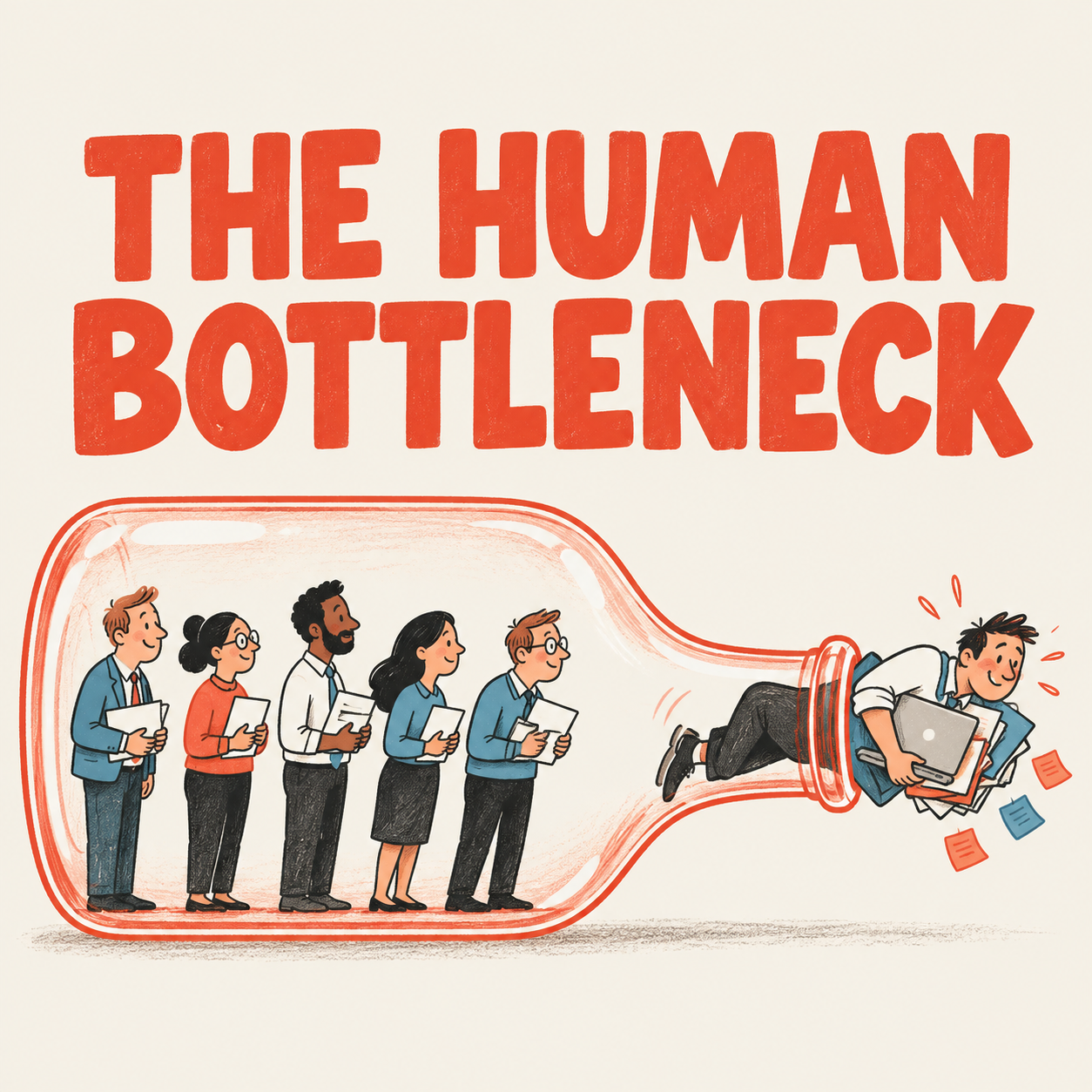
It is easy to praise the person who always knows the answer, responds the fastest, and steps in when something gets stuck.
But if every problem is solved through the same person, the organization may be rewarding heroics while weakening its own capacity.
Good management asks different questions:
Where is work waiting? What knowledge exists only in someone’s head? Who owns the next decision? What would allow more people to handle this without escalation?
The goal is not to make the expert less valuable. It is to make the system less dependent on their constant availability.
I know this because, for a while, I was part of the bottleneck.
I had accumulated a lot of context: where the answer lived, which exception mattered, and what had happened before. That knowledge helped me give people the answer they needed in the moment.
But it was a double-edged sword.
I could answer the immediate question, but I could not always slow down enough to make sure the other person was equipped to solve the next version of the problem. And while I was answering one question, other bottlenecks were forming somewhere else.
I was helping, but I was also becoming part of a system that depended on individual rescue instead of building shared capability and accountability.
The metaphor is almost too literal: imagine a bottle with a wide body and a narrow neck. Inside the bottle, there is plenty of information, energy, and activity. But everything still has to pass through the same small opening.
The problem is not always a lack of capacity. Sometimes too much work, knowledge, or judgment has been routed through one place.
And the person at the neck may be doing a good job. They may be smart, generous, and deeply committed. They may be the reason the system works as well as it does.
That is what makes the bottleneck so easy to miss.
Being helpful can disguise the fact that an organization has become dependent on one person’s availability.
A teammate needs to know where a decision was made.
A leader needs to understand whether a contract meets a particular requirement.
A family request needs context before someone can respond.
A compliance plan needs owners, evidence, and next steps.
An attendance pattern needs to be noticed before it becomes a crisis.
The information may already exist. The problem is that it is scattered across inboxes, documents, spreadsheets, conversations, and memory. So everyone keeps returning to the same person who knows how to assemble it.
That person becomes the search engine, translator, historian, and routing system.
Eventually, even simple work starts waiting in line.
Helping judgment travel farther
That is where thoughtful automation can help.
A contract reader can identify relevant language, flag an exception, and show a human reviewer why the agreement needs attention.
A compliance planning tool can turn scattered obligations into a working register of owners, evidence, cadence, and open questions.
An attendance-intervention plugin can help a district team notice patterns earlier, bring the right context into view, and prepare for the next conversation.
An enablement system can turn recurring questions and informal workarounds into guidance that more people can use.
None of these tools eliminate judgment.
They help judgment travel farther.
That distinction matters. The goal is not to automate every decision or replace the person who has earned everyone’s trust. The goal is to stop making that person the only available path to a good decision.
The most useful automation may not be the thing that produces the most impressive output.
It may be the thing that helps more people understand what is happening, what matters, and what they can do next.
The goal is not to remove the person who carries the knowledge. It is to make that knowledge visible, usable, and teachable.
The best place to start may be the person everyone keeps waiting for.
← Back to U Can